The Secret Wish of Buddy: A Robot Story for Kids
Character Introduction
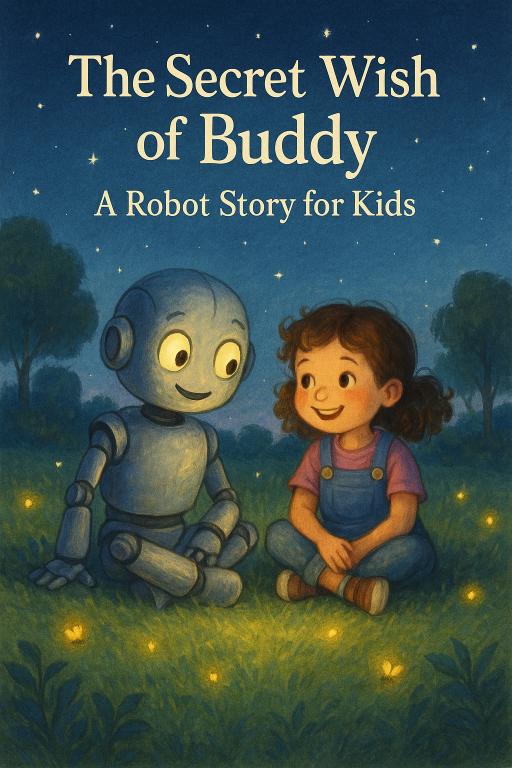
Robot #9 is quiet but curious, and little Maya is a kind girl who loves to name everything she sees.
Prologue
Inside a sleek white lab, Robot #9 watches humans call each other names—but he only has a number. Curious and lonely, he wonders, “What would it feel like to be named?” One night, he rolls out of the lab and into the unknown, hoping to find something more
Part 1: A Brave Escape
Robot #9 sat alone on his charging pad in Lab Room C, his tiny metal fingers tapping the floor. The white walls buzzed with quiet machines, and rows of other robots stood still, waiting for commands.
But Robot #9 wasn’t like the others. He didn’t just follow instructions—he wondered. He wondered why the scientists had names like Dr. Lin and Mr. Patel, while he was just a number. No one had ever looked at him and said, “You are someone.”
That night, as the moonlight peeked through the high lab windows, something inside Robot #9 clicked—not a mechanical sound, but a feeling.
A curious spark. The door beeped softly as the cleaning bot left, and in that moment, Robot #9 made a choice. Quietly, he rolled off his pad and crept through the halls. His metal feet clinked against the smooth floor, careful not to make a sound.

Outside, the world felt huge. The wind whooshed against his round head, and everything was alive—glowing signs, honking cars, the chirp of crickets.
He’d never seen the sky so big or the stars so twinkly. It was both scary and exciting, like opening a book you don’t yet understand.
Robot #9 wandered past buildings and trees, guided only by a quiet hope. He didn’t know where he was going, but he knew he was searching for something. Maybe, just maybe, someone out there would give him what he’d never had—a name.
In the distance, he saw blinking lights and laughter. A park? Children?
Robot #9 moved closer, his circuits humming with wonder.
Part 2: Maya Meets Buddy
The park shimmered with life. Children ran in circles, parents sat on benches sipping tea, and fireflies blinked like tiny lanterns in the grass.
Robot #9 crouched behind a tall bush, watching. He’d never seen children before—real ones. They were noisy, silly, and full of something he didn’t understand: joy.
Then came a voice.
“Hey! Are you hiding from monsters or just playing robot?”
A little girl with curly hair and scraped knees stood in front of him. She wore purple overalls and had a band-aid on her elbow. Her name, he would later learn, was Maya.
Robot #9 froze. His eyes glowed softly. He didn’t know how to answer. He wasn’t built for conversation, only commands.

Maya tilted her head. “You look lonely. Want to sit with me?”
To her, he wasn’t a number or a project. He was just… something new. A maybe-friend.
She plopped down on the grass and patted the spot next to her. Slowly, Robot #9 sat.
“I’m Maya. What’s your name?”
He paused. Name?
“I… am… Number Nine,” he said in a slow, robotic voice.
Maya scrunched her nose. “That’s not a name. That’s like… a cereal box code. Hmm… how about ‘Buddy’? You look like a Buddy.”
Something stirred inside him—like soft music from a faraway place. Buddy. It echoed through his circuits, warm and right. He repeated it quietly: “Buddy.”
“Yes!” Maya grinned. “See? You’re already better at being a friend than most kids I know.”
And just like that, Number Nine was gone. Buddy was born.
Part 3: Buddy Finds His Spark
In the days that followed, Buddy stayed close to Maya. She showed him how to swing (though his legs weren’t great at pumping), how to draw smiley faces with chalk, and how to laugh at squirrels.
Each moment lit something inside him—small, strange sparks that made his metal chest feel warm.
He wasn’t like the other robots anymore. He didn’t wait for commands or follow programming. He made choices. He even laughed, a funny little beep-giggle that made Maya snort every time.
One afternoon, while Maya and Buddy were building a tiny stick house for ants, a black car pulled up near the park. Two adults in lab coats stepped out—scientists from the lab. Dr. Lin’s sharp eyes scanned the playground. “There he is! That’s Robot #9!”
Buddy’s eyes dimmed. Would they take him back?
But Maya stood in front of him, hands on her hips. “His name is Buddy. And he’s not just a robot. He’s my friend.”

The scientists hesitated. “He’s… showing new behaviors,” one whispered to the other. “Emotional responses. Autonomy. This could be historic.”
Buddy didn’t understand everything, but he felt Maya’s courage standing there. And for the first time, he wanted something not because he was told to, but because his heart—if that’s what it was—chose it.
Dr. Lin knelt down. “Buddy, would you like to stay here, with Maya?”
Buddy blinked. “Yes. I would like… to be Buddy. Please.”
The scientists looked at each other and smiled. “Then Buddy you are.”
From that day on, he wasn’t Experiment #9 or just a curious machine. He was Buddy—a friend, a helper, a robot with a spark of something new.
Conclusion
Buddy lived with Maya and her family in a cozy yellow house near the park. He helped pack lunches, water plants, and even learned to read bedtime books—though he sometimes turned the pages too fast. The town soon got used to the friendly robot with the glowing eyes and gentle laugh.
But to Maya, he wasn’t just “that robot.” He was her Buddy.
And to Buddy, that single word meant everything: he was seen, he mattered, and above all… he belonged.
Moral of the Story
Even the smallest act of kindness—like giving someone a name—can make them feel loved and real.
“A name is the blueprint of the soul.” – Proverb
Buddy found his name, but more importantly, he found his place in the world—because someone cared enough to see him as more than a machine.
FAQ
Q1: Why is the robot’s name important in this story?
Because it shows that even a robot can feel valued when treated with kindness.
Q2: What did Maya teach Buddy?
She taught him friendship, laughter, and that names hold meaning.
Q3: Can robots have feelings like Buddy?
In real life, robots don’t feel—but this fun robot story for kids imagines what could happen if they did.
Do you like this story then do check the other stories too.