The Date Seed: A Powerful Islamic Story of Faith
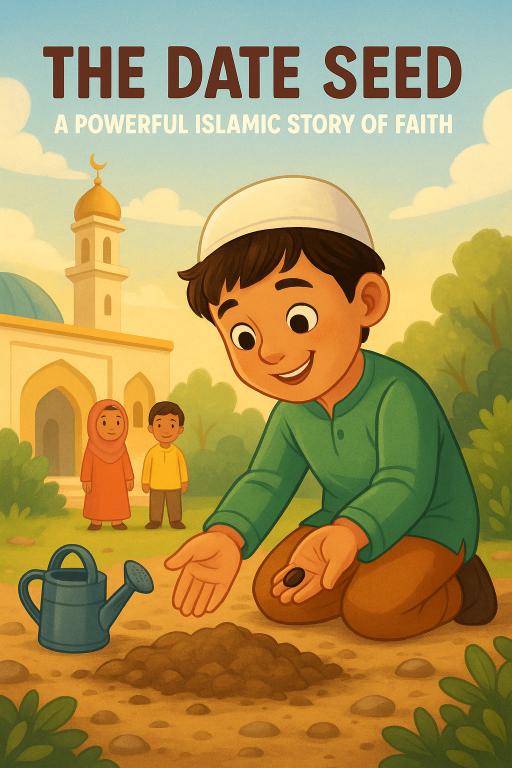
Character Introduction
Zayd, a curious and kind-hearted 7-year-old boy, lives in a peaceful town with his mother and loves listening to stories about the Prophet Muhammad ﷺ.
Prologue
Zayd often hears his mother talk about small good deeds and their rewards in the Hereafter. One day, while helping in their garden, Zayd finds a shiny date seed and wonders, “Can something so tiny do anything good?” His mother smiles and tells him a special hadith about the Prophet ﷺ and the seedling — and that little things matter when done for Allah.
Part 1: The Prophet’s Seedling Advice
Zayd was a curious little boy with big brown eyes and a heart full of questions. He lived in a quiet town with his loving mother, who always shared stories about the Prophet Muhammad ﷺ. Every evening, after Maghrib prayer, Zayd would snuggle next to her and listen carefully.
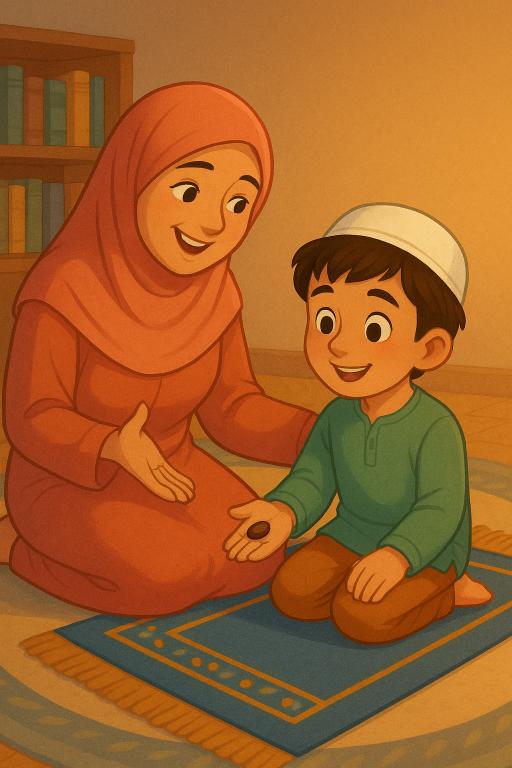
One night, as the sky turned pink and stars peeked out, Zayd sat cross-legged on the prayer mat. “Mama,” he asked, “Do small things really matter to Allah? Like… really small?” He held up a dry date seed he had found near the garden. “Like this?”
His mother smiled and gently took the seed from his palm. “Yes, Zayd. Even this.”
Then she leaned in closer and said, “The Prophet Muhammad ﷺ once said: ‘If the Day of Judgment comes while you have a seedling in your hand, plant it.’”
(Musnad Ahmad 12902 – Sahih)
Zayd blinked. “Even if the whole world is ending?”
“Even then,” she nodded. “Because planting something good—even if it’s small—is still a good deed. And Allah sees every single good thing we do.”
Zayd looked at the seed again. It didn’t look special. Just a tiny, brown thing. But now it felt… important.
The next morning, he woke up early and held the seed tightly in his fist. He looked around his neighborhood and saw an empty patch of dry land beside the masjid. It was full of pebbles and weeds. People passed by it every day but never stopped.
“I’ll plant it there,” Zayd whispered.
He found a small spade, a little watering can, and asked his mother for help. She didn’t ask why. She just smiled and walked with him to the patch of land. The ground was hard, but Zayd kept digging, scooping, and patting it gently.
He placed the seed into the soil and said softly, “Bismillah.”
As he poured water over it, a few neighbors watched from their porches. One of them, an old uncle, scratched his beard. “What’s that boy doing with a seed?” he muttered.
But Zayd didn’t hear. His heart was too full of hope.
He didn’t know if the seed would grow. He didn’t know if anyone would notice.
But he remembered what his mother said:
“Allah sees every good thing.”
And that was enough to make him smile.
Part 2: The Lonely Garden Patch
The sun was high in the sky, and the birds chirped softly as Zayd stood in front of the patch of land beside the masjid. It looked tired—just dirt, tiny stones, and a few scraggly weeds that danced in the wind. No one had ever tried to plant anything here. It was like the ground had been forgotten.
But not by Zayd.
He crouched down and touched the soil with his fingers. It was dry and crumbly. He poured a little water from his small metal can, and the ground made a soft sucking sound as it drank. His mother stood nearby, watching quietly. “It will take time,” she said gently.

“I know,” Zayd nodded. “But it’s worth it.”
He cleared away the pebbles and plucked out the weeds. Then he smoothed the earth with his hands and carefully pressed his little date seed into a cozy hole he had dug with his spade. He whispered again, “Bismillah.”
Each day after that, Zayd came to the patch after school. He watered it gently, sometimes even bringing leftover tea water or the last drops from his lunch bottle. He watched the sun rise and fall over the spot, hoping for a tiny green sprout.
Sometimes he would sit cross-legged near it and make du’a, “Ya Allah, please help this seed grow. Let it become something good.”
The people who walked by the masjid often glanced at him. Some gave a nod, others looked confused. But no one stopped to ask what he was doing.
One morning, while Zayd was pulling out some dry grass, a young boy from the neighborhood walked by with his cricket bat.
“What are you doing?” the boy asked.
“I planted a date seed,” Zayd said proudly.
The boy looked at the empty patch. “There’s nothing there.”
“Not yet,” Zayd smiled, brushing dust off his knees. “But one day, there will be.”
The boy blinked, shrugged, and walked away, mumbling, “Weird.”
But Zayd didn’t mind. The hadith still echoed in his heart.
“If the Day of Judgment comes… plant it.”
This wasn’t just dirt anymore. It was a place of hope.
As the wind blew gently across the little garden patch, Zayd whispered, “You’ll grow one day. I believe in you.”
And somewhere in the unseen, perhaps the angels wrote down a good deed in Zayd’s name.
Part 3: The Laugh and the Lesson
It had been many days since Zayd planted his little seed. The earth still looked plain, but Zayd didn’t give up. Every day, after school and prayer, he returned to the same dusty patch beside the masjid—watering, clearing tiny weeds, and whispering du’a.
One afternoon, as he knelt beside the patch with his spade, two older boys from the neighborhood walked past, bouncing a football between them.
“Hey, look at Zayd!” one of them laughed. “Still playing gardener?”
Zayd looked up. “I’m not playing. I planted a date seed.”
The other boy raised an eyebrow. “A date seed? That’ll take forever to grow!”
“Maybe even years,” the first one snorted. “And what’s the point? Who’ll even care about your tiny tree?”
They both laughed loudly and ran off, kicking their ball down the street.
Zayd’s face turned red, but he didn’t say anything. He looked back at the soil. It still looked the same—no sprout, no green. Just quiet earth.

For a moment, he felt small… silly, even. Maybe they’re right, he thought. Maybe I’m wasting time.
But then he remembered the hadith again.
“If the Day of Judgment comes while you have a seedling in your hand, plant it.”
Zayd whispered, “Even if no one sees, Allah does.”
He took a deep breath, picked up his watering can, and gently poured a small stream onto the spot.
That evening, he told his mother what happened. She listened carefully, then held his hand.
“Do you know why people laugh sometimes?” she asked. “Because they don’t understand. The Prophet Muhammad ﷺ was also laughed at. People didn’t believe in his message. But he never stopped planting goodness.”
Zayd looked up. “He didn’t?”
“No,” she said. “He kept planting, even when others walked away. And now we are Muslims because of those seeds.”
Zayd felt a warmth in his chest. He wasn’t just planting a tree. He was planting faith. Hope. A message that small things matter.
The next morning, Zayd added a small painted stone near the seed with the words:
“Plant Goodness.”
Some people still passed by without noticing. But others began to slow down. A few even smiled.
Zayd smiled too—because now, he wasn’t just planting a tree.
He was planting something in people’s hearts.
Part 4: A Surprise Visitor
One cool afternoon, as the wind gently rustled the trees and the adhan echoed from the masjid, Zayd was busy removing a fresh patch of weeds from his garden. The little seed had still not sprouted, but Zayd’s care had made the soil cleaner, softer, and more welcoming.
A few tiny flowers had started blooming nearby—seeds blown in by the wind, watered by Zayd’s kindness.
As Zayd hummed quietly and watered the spot, a soft voice called out, “Assalamu Alaikum, little gardener.”
Zayd looked up, surprised.
It was Imam Kareem, the gentle, wise imam of the masjid. He wore a long white robe and carried a walking stick with a carved olivewood handle. Zayd quickly stood and wiped his hands on his shirt.
“Wa Alaikum Assalam, Imam Sahib!” Zayd said, heart racing.
“I’ve seen you here every day,” the imam smiled. “Tell me, what are you planting?”
“A date seed,” Zayd replied proudly. “I wanted to do something good… even if it’s small.”
The imam’s eyes softened. He knelt beside Zayd and placed a kind hand on his shoulder.
“You know,” he said, “the Prophet Muhammad ﷺ once said that whoever plants a tree, and a bird or animal eats from it, it counts as charity for them.”
(Sahih Bukhari 2320)
Zayd’s eyes widened. “Really?”
“Yes,” the imam nodded. “And not only that—he loved green spaces and clean places. What you’re doing is part of our deen. It’s worship.”
Zayd smiled shyly.
Just then, the same two boys from before walked past again, this time kicking stones. They paused, surprised to see the imam sitting next to Zayd.

“What are you two doing?” one asked.
The imam turned to them. “Zayd is teaching us something. Would you like to learn too?”
The boys looked at each other awkwardly.
“It’s just a seed,” one muttered.
“Ah,” the imam said gently, “but some seeds grow into date palms that feed entire villages. And some grow into kindness that feeds hearts.”
The boys didn’t know what to say.
Zayd looked at them and smiled. “You can help me if you want. I need more hands to clear the weeds.”
The boys hesitated… then slowly stepped forward.
That day, for the first time, Zayd wasn’t alone. With the imam’s gentle guidance, and Zayd’s quiet faith, a little garden of goodness had begun to grow—not just in the soil, but in the hearts of those around him.
Part 5: Green Gifts and Grateful Birds
Weeks passed, and though the little date seed still hadn’t broken through the soil, something else had started to bloom—something even more beautiful.
Tiny green plants had begun to grow near Zayd’s patch. They weren’t from his date seed, but from other seeds carried by the wind or dropped by birds. Some were little pink flowers, some were grassy shoots, and one even looked like a mini sunflower.
Each day, Zayd tended to all of them with care. He didn’t just water them—he spoke to them kindly, picked out weeds, and placed small flat stones around the edges like a border.
Neighbors began to notice. One aunty placed a small clay bowl of water nearby “for the birds,” she said with a wink. A little boy brought a packet of seeds and asked, “Can I plant something too?”
Zayd nodded. “Of course! Goodness is something we can all share.”
Even the two boys who once teased him now visited often. They helped rake the soil and take turns filling the water can. The spot beside the masjid—once dry and forgotten—now looked like a happy corner of Jannah.
One morning, Zayd spotted a pair of small yellow birds chirping and hopping between the flowers. They dipped their beaks into the water bowl, fluffed their feathers, and flew off.
His heart fluttered with joy.
“Mama,” Zayd said that night, curling up beside her, “The birds came today. I think they liked it.”
His mother kissed his forehead. “And I think they made du’a for you. Do you remember what the Prophet ﷺ said?”
Zayd sat up, eyes shining.
“He said that if a person plants something and a bird eats from it, it counts as charity!”
(Sahih Bukhari 2320)
“That’s right,” she nodded. “Even the birds are part of your sadaqah.”
Zayd grinned. “Even if the seed doesn’t grow, I’m still happy.”
And deep down, he knew: something had already grown—a place of beauty, a habit of goodness, and a feeling of peace in his heart.

That night, Zayd fell asleep with a smile, knowing that even the tiniest seed can bring joy when planted with faith.
Part 6: A Tree for Jannah
Years passed.
The town changed—houses grew taller, children grew older, and the masjid was repainted in soft white and blue. But one thing remained the same: the little garden patch beside the masjid.
Except it wasn’t little anymore.
Zayd, now almost a young man, stood in front of the spot where he once planted that single date seed. He smiled as he shaded his eyes from the sun. Above him stood a tall, leafy date palm tree—its green fronds swaying in the breeze, its trunk strong and rooted deep in the earth.
Children from the neighborhood played under its shade. Some sat reading Qur’an, while others giggled as they chased each other around its base.
Zayd’s little sister, Amal, tugged his sleeve. “Is this your tree?” she asked, wide-eyed.
He nodded. “A long time ago, I planted a seed right here.”
She looked up at the tree, amazed. “And now it’s this big?”
“It took many years,” Zayd said, smiling gently, “and a lot of du’a, water, and patience. But yes, this is the same tree.”
Amal looked thoughtful. “Does that mean… every time someone eats a date, or sits in the shade, you get rewards?”
Zayd nodded. “That’s what the Prophet Muhammad ﷺ taught us. Every good deed keeps growing, even after we forget it.”
Just then, the imam walked by and stopped beside them. “MashaAllah,” he said, gazing up at the date tree. “Do you remember, Zayd, what your mother told you that first day?”
Zayd did.
“She told me… ‘Allah sees every good thing we do.’”
The imam smiled. “And now this tree stands as a witness.”
Zayd placed his hand on the rough bark. He whispered, “Ya Allah, accept it from me.”
Amal looked up at her brother. “Will you teach me how to plant something too?”
Zayd looked down at her and nodded. “Yes. But not just with seeds—we can plant smiles, kind words, even helping hands.”
As the sun began to set, the call to prayer rang out gently. The tree swayed in the breeze, like it, too, was answering the call.
And Zayd knew: one small seed, planted with faith, could become a tree in this world… and maybe even one in Jannah.
Conclusion
Zayd’s little act of faith had bloomed into something far greater than he ever imagined. What started as a single date seed became a source of shade, food, joy, and inspiration for others. It showed that even the smallest deed—done with sincerity for Allah—can grow and grow and grow.
Moral of the Story
This story teaches us that planting goodness—whether it’s a seed, a smile, or a kind word—is never wasted. Allah loves even the tiniest of good deeds when they are done with pure intentions. Just like Zayd’s seed turned into a tree, our acts of kindness can grow into something beautiful, both in this world and the Hereafter.
📖 “If the Day of Judgment comes while you have a seedling in your hand, plant it.”
— Prophet Muhammad ﷺ
(Musnad Ahmad 12902 – Sahih by Al-Albani)
FAQ
1. Why did Zayd plant the date seed even though it was small?
Because he believed that even small good deeds matter to Allah.
2. What did the Prophet Muhammad ﷺ say about planting a seed?
He said that even if the Day of Judgment comes, we should still plant it.
3. Why did people laugh at Zayd in the beginning?
They thought planting a seed was silly because it would take a long time to grow.
Do check the other stories too.