The Farmer’s Du’a: A Powerful Tale of Patience and Prayer

Character Introduction
- Farmer Yaseen – A kind, elderly farmer with strong faith and a heart full of hope.
- Mariyam – Farmer Yaseen’s cheerful and curious granddaughter who asks many questions.
- Village Imam – A wise and gentle man who reminds people to stay strong in du’a and salah.
Prologue:
In a quiet village surrounded by golden fields, lived an old farmer named Yaseen. Every morning, he woke up early, thanked Allah, and offered his salah before heading to his dry, cracked fields.
There had been no rain for months, and his crops were dying. Yet, Farmer Yaseen never missed a single prayer and always raised his hands for du’a. His neighbors had started losing hope, but he held on. Little did they know, something beautiful was on the way.
Part 1: The Cracked Earth
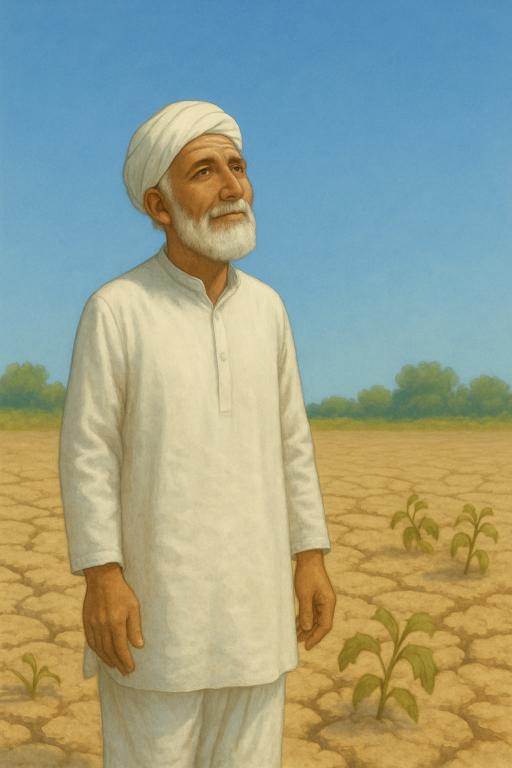
Farmer Yaseen lived in a peaceful village surrounded by tall trees, narrow paths, and wide fields. He was an old man with a kind smile and a soft voice. Every day, he wore his simple brown kurta, tied his turban neatly, and walked to his fields with his wooden stick.
But something was wrong this year. The rain hadn’t come.
The ground had turned hard and dry. Cracks ran through the soil like tiny rivers. The plants were weak. The leaves turned yellow. The animals had no green grass to eat, and even the well in the village was getting low on water.
The other farmers stood around in worry. Some shook their heads, some sat quietly in sadness. But Farmer Yaseen did something different. He walked to the masjid five times a day, offered his salah, and made du’a every single time.
“Ya Allah,” he whispered, raising his old hands to the sky, “send rain to our village. Your mercy is endless.”
The people around him began to wonder.
“Why do you keep praying, Yaseen?” one farmer asked. “It hasn’t rained in months.”
“Because Allah listens,” Yaseen replied gently. “And du’a is never wasted.”
But deep inside, even Farmer Yaseen was feeling tired. The days were getting hotter. The clouds were empty. Still, he kept going—one prayer at a time.
At home, his little granddaughter Mariyam would wait for him by the window. She saw the sweat on his face and the dust on his shoes, but he always smiled.
“Did it rain, Nana?” she would ask.
“Not yet,” he would say, “but soon, Insha’Allah.”
And then, every night, he prayed again.
Part 2: Little Mariyam’s Big Question
One hot afternoon, Farmer Yaseen sat under the old neem tree outside his house. His face looked calm, but his eyes showed tiredness. Mariyam, his seven-year-old granddaughter, came running with two cups of cool water.
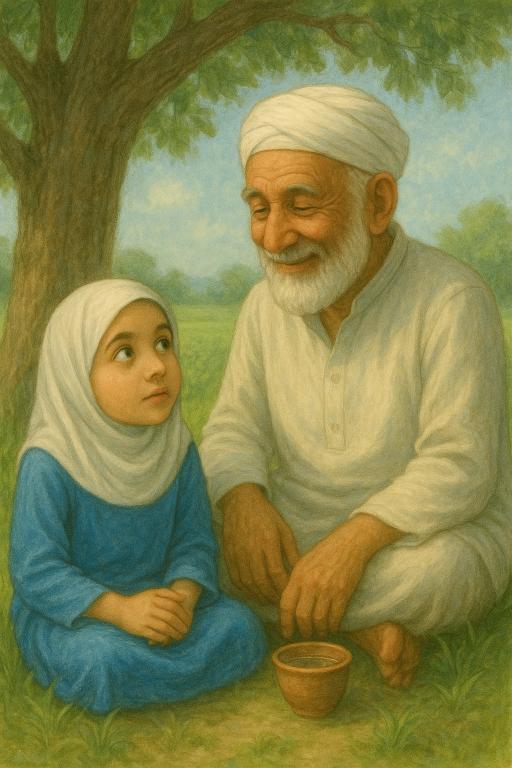
“Nana, drink! You must be so tired,” she said, handing him the cup.
Farmer Yaseen smiled and patted her head. “JazakAllah, my sweet Mariyam.”
She sat beside him, swinging her little feet. Then, after a long pause, she looked up and asked softly, “Nana… why do you still make du’a every day… if the rain doesn’t come?”
Yaseen looked at her gentle eyes and smiled. “Because du’a is not like asking for a toy and getting it right away. It’s like planting a seed. You water it with your prayers, and one day, it will bloom.”
“But what if it never rains?” she asked, tilting her head.
“Then Allah will still reward us for asking,” Yaseen replied. “Sometimes Allah answers quickly, sometimes later, and sometimes in ways we don’t even see. But He always hears.”
Mariyam thought about that for a moment. Then she whispered, “Can I make du’a too?”
“Of course,” said Yaseen. “Allah listens to little voices too.”
That night, Mariyam stood beside her grandfather during salah. Her tiny hands raised toward the sky, and she said in a soft voice, “Ya Allah, please send rain so Nana’s plants can grow, and our animals can drink. Ameen.”
The stars above twinkled gently as if they had heard her too.
From that day, Mariyam never missed du’a after prayer. Even when her friends played outside, she’d take a moment to pray, remembering what her grandfather said:
“Du’a is never wasted.”
Part 3: The Imam’s Visit
One bright morning, the village masjid echoed with soft footsteps. The village imam, a gentle man with a white beard and kind eyes, came walking down the path with his walking stick in hand. He had heard of the long drought and the sadness in the farmers’ hearts.
The people gathered under the banyan tree to listen. Farmer Yaseen sat quietly with Mariyam beside him, holding his hand.
The imam raised his voice just enough for all to hear. “My dear brothers and sisters,” he said, “do you think Allah has forgotten us? No. Allah never forgets His people.”
“But we have been praying for so long,” one man called out. “Still, no rain.”
The imam nodded. “Yes. But sometimes Allah delays a blessing because He loves the sound of your voice calling Him.”
He then told them the story of Prophet Ayyub (AS)—a noble man who lost everything: his health, wealth, and family. Yet, he never stopped making du’a and never missed his salah. And when the time was right, Allah gave him more than he had lost.
Farmer Yaseen’s eyes filled with tears. Mariyam leaned closer, listening carefully.
The imam continued, “Allah says in the Qur’an:
‘Indeed, Allah loves those who are patient.’ (Surah Al-Imran 3:146)
He then reminded the villagers, “Do not let shaitan trick you into giving up. If the rain hasn’t come yet, it means Allah is still testing us. But every test is followed by ease.”
The villagers looked at one another. Some nodded slowly. Others wiped their eyes.
“Let us all return to our salah,” the imam urged, “and raise our hands in sincere du’a—together, as one ummah.”
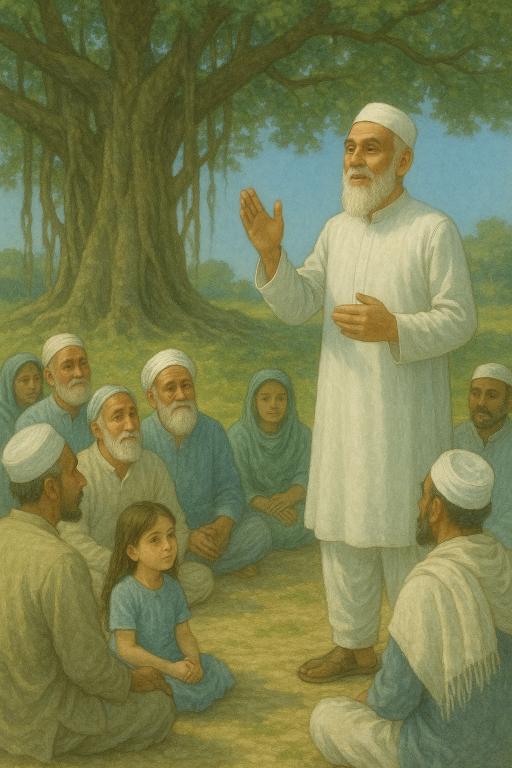
That day, more people filled the masjid. The air was still dry, but hope had returned to the village—planted like a small seed, ready to grow.
And little Mariyam? She made a new du’a that night:
“Ya Allah, please don’t just send rain. Please send faith into every heart.”
Part 4: A Test of Patience
Another week passed, and the sky remained quiet.
The sun blazed above the village like a burning lantern. Leaves curled up. Chickens rested in the shade. Even the breeze seemed tired.
Farmer Yaseen walked slowly across his field, now dusty and dry. The stalks of wheat lay flat, thirsty for water that never came. His old hands trembled as he touched the soil. His heart ached—but his faith did not bend.
At home, Mariyam noticed how tired her grandfather looked. She brought him a glass of water and sat beside him.
“Nana,” she said gently, “I’m still making du’a.”
He smiled, though his eyes looked weary. “That’s what keeps me going, my dear.”
In the village, not everyone remained strong. Some people began to complain again.
“It’s no use,” said one. “The sky has forgotten us.”
“Maybe we prayed wrong,” said another.
Yaseen said nothing. He simply walked to the masjid again, bowed in salah, and whispered his du’a with tears in his eyes. His back ached. His knees hurt. But he stayed in sujood longer than usual that day.
That night, after Maghrib prayer, Mariyam asked him, “Nana, are you sad?”
He nodded slowly. “Yes, a little. But I remember what the imam said—Allah loves the patient.”
Mariyam thought for a moment and then jumped up. “Let’s go outside! I want to show you something.”
She led him to the hilltop near their home where the stars were bright above.
“Look,” she said, pointing up. “Even if the clouds are missing, the sky is still beautiful.”
Yaseen looked up and smiled, deeply touched. “You’re right, Mariyam. Beauty is always there—sometimes we just need to be patient to see it.”
Hand in hand, they stood beneath the open sky, whispering another du’a into the wind.
Part 5: The Night of the Storm
One late evening, the village lay silent. Chickens had gone to their coops. Lanterns flickered in windows. Even the trees looked still.
Farmer Yaseen woke up before Fajr for his Tahajjud prayer, as he often did when his heart felt heavy. The room was cool and dark. He made wudu quietly and laid out his prayer mat. Mariyam, still half asleep, watched from her bed.
As Yaseen bowed in sujood, his voice trembled.
“Ya Allah, we are nothing without Your mercy. We are weak, but You are strong. Please send us rain, not just for our fields—but for our hearts.”
Just then, a low rumble echoed in the distance. He paused.
Another rumble—closer this time.
Mariyam sat up. “Nana… was that thunder?”
He walked to the door, opened it slowly—and there it was.
The wind had begun to blow. Not hot, dry wind like before, but cool and full of life. In the distance, clouds were gathering, rolling like waves across the dark sky. A bright flash of lightning danced over the hills, followed by another deep, thunderous sound.
Mariyam ran to the doorway, wide-eyed. “Is this… real rain?”
Yaseen’s voice choked with emotion. “Insha’Allah… yes.”
The wind picked up, sweeping dust into the air, shaking trees, and flapping clothes on lines. A few droplets fell—just tiny taps at first, like the sky was gently knocking.
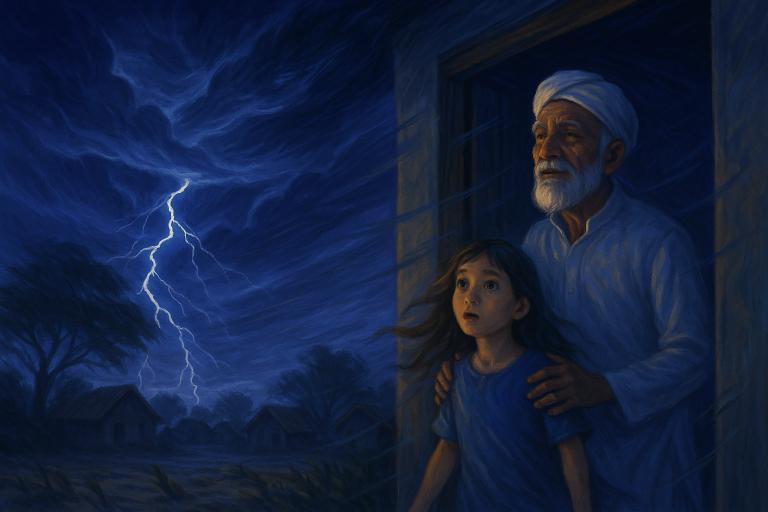
Mariyam held her arms out. “It’s cold!” she laughed. “It’s really rain!”
Yaseen looked up at the sky with his hands raised high and whispered,
“Alhamdulillah… Ya Rabb, You never forgot us.”
And above them, the sky answered—not with words, but with raindrops that fell one after another… and then all at once.
The land had waited long. And now, the wait was over.
Part 6: Rain, Mercy, and Joy
By morning, the village looked completely different.
The once-dusty ground now smelled sweet and fresh. Tiny puddles shimmered in the early light. Birds chirped loudly, hopping in the wet grass. Children laughed, splashing barefoot in the mud.
Farmer Yaseen stood by his field, the earth now soft beneath his sandals. Water trickled down the cracks, soaking into the roots of his dry crops. The plants stood a little taller already—like they were stretching after a long, tired sleep.
All around, villagers hugged and smiled. Someone called out,
“Allah has answered! Look at this mercy!”
Some cried. Others gave thanks. But everyone remembered the du’as they had once whispered, thinking no one heard.
Yaseen stood silently, his eyes full of tears—not of sadness, but of deep, grateful joy.
Mariyam ran to him, her clothes soaked, hair dripping. “Nana! The ducks are swimming in the pond again!”
He chuckled and picked her up. “Alhamdulillah, Mariyam. This is all from the mercy of Allah.”
They walked together through the soft rain as the clouds gently emptied their blessings.
That evening, when the village gathered for Maghrib prayer, the masjid was full. The imam smiled at the crowd and reminded them:
“This rain did not fall from the clouds… it fell from your du’as and your patience.”
Mariyam held her grandfather’s hand tightly. She didn’t need to ask questions anymore. She had learned the most important lesson of all:
Never give up on du’a. And never leave salah. Even when the sky is empty—Allah is listening. Always.
Conclusion
The village that once waited in silence now bloomed with life. Crops grew. Animals danced in puddles. And children played under the smiling sky. But more than the rain, something else had changed—hearts had grown stronger in faith.
Farmer Yaseen’s patience had taught everyone that the best harvests come not just from water, but from trust in Allah. And little Mariyam? She would never forget that rainy day… or the power of a whispered du’a.
Moral of the Story
Never give up on du’a and never stop offering salah—Allah always hears, and He always responds, in the best time and the best way.
“Call upon Me; I will respond to you.”
— Surah Ghafir (40:60)
The Prophet Muhammad (ﷺ) said:
“The supplication of a servant is granted as long as he does not ask for a sin or for breaking the ties of kinship, and as long as he is not impatient.”
— [Sahih Muslim 2735]
FAQ
1. Why didn’t the rain come right away when Yaseen made du’a?
Because Allah answers when the time is best. Du’a is never wasted.
2. Why did Mariyam start making du’a too?
She learned from her grandfather that Allah listens to everyone—even children.
3. What lesson did the village learn?
They learned to return to salah and never lose hope in Allah’s mercy.
4. Who was the Prophet mentioned by the imam?
Prophet Ayyub (AS), known for his patience during great hardship.
5. What is the most important takeaway from this story?
That du’a and salah are powerful tools of hope—even in the hardest times.
Explore more inspiring tales about faith, kindness, and patience here.